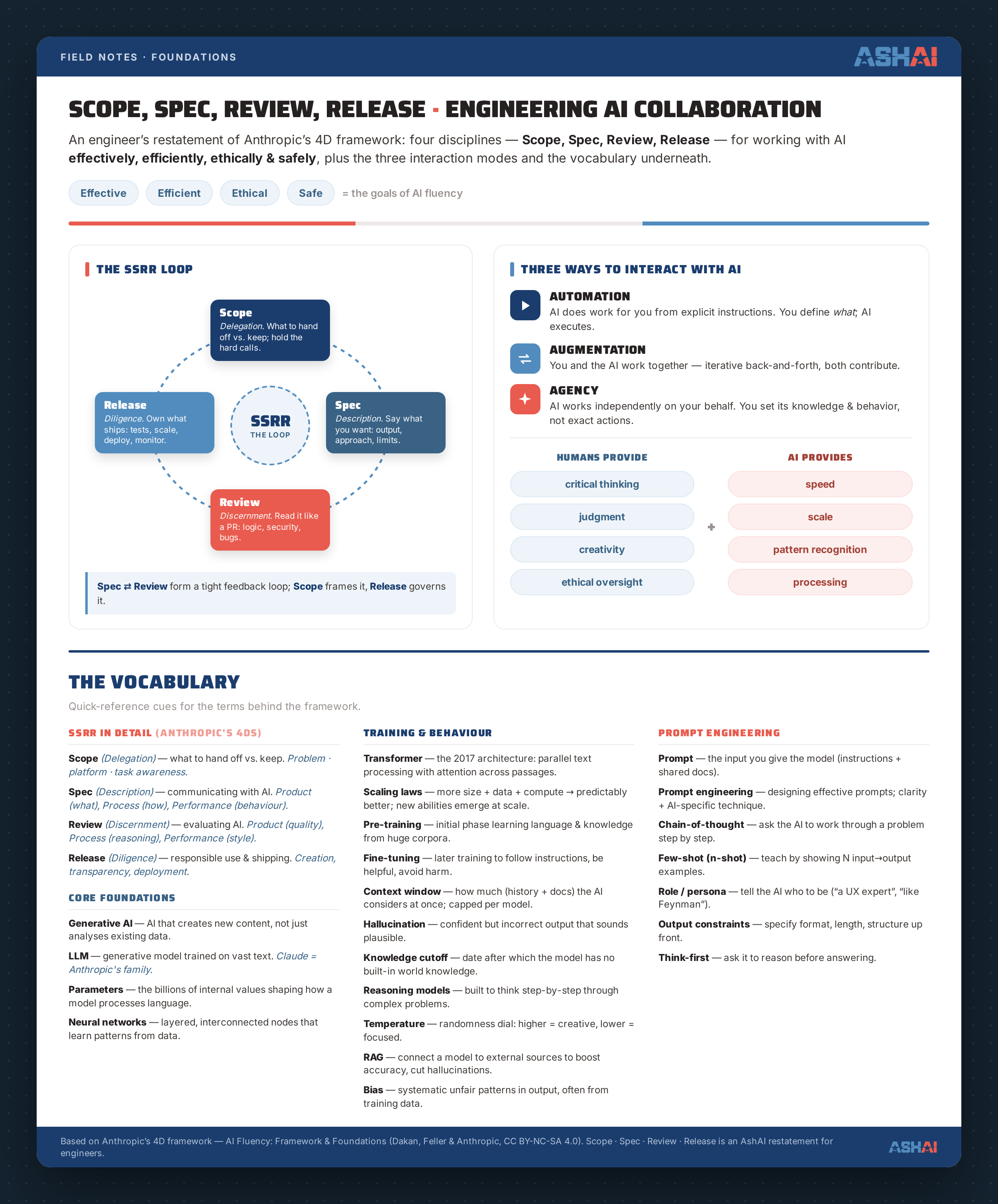
AI Fluency: 1. Three Ways to Work With AI · 2. Scope, Spec, Review, Release · 3. Leading an AI-Augmented Team
Your team is already using AI. They just don't agree on how.
One engineer ships whatever Claude returns. Another won't let it near anything that matters. A third is doing genuinely good work with it but couldn't tell you why it works. You have no shared language for any of it — so you can't set a standard, review the approach, or coach the people getting it wrong.
That's a leadership problem, not a tooling one. The fix is a shared vocabulary — the same four habits from the last post: Scope, Spec, Review, Release. (Anthropic frames them as the 4Ds — Delegation, Description, Discernment, Diligence; SSRR is the engineering restatement.) Here's what each one looks like when you're leading a team, not just doing the work yourself.
Scope — deciding what AI should even touch
The decision before the prompt: what goes to a human, what goes to AI, what gets split. Most teams skip it and default into an answer. The conversation I want in a design review isn't "did you use AI" — it's "what did you hand off, and why." Scope is just engineering judgment, pointed at a new kind of teammate.
Spec — saying what you actually want
Communicating with the AI: the product (what the result should be), the process (how to approach it), and the performance (be terse, be skeptical, show your work). Most "AI doesn't work for us" complaints are spec failures — vague input, vague output. It's a coachable skill, and naming it makes it teachable.
Review — the part that's actually your bar
Critically evaluating what comes back — the output, the reasoning behind it, and whether the interaction even serves you. A capable model's output reads well and is sometimes wrong. Spec and Review form a loop: you spec it, you evaluate, you re-spec. The quality of an engineer's AI work is mostly the quality of that loop — and building it in your juniors is the job.
Release — owning what ships
In the last post, Release was the production umbrella — tests, scaling, the deploy, the page at 2 a.m. For a team, it's also the accountability layer, and that part is cultural. Whoever's name is on the PR owns every line, regardless of what wrote it. But ownership only works if people are honest about how the work got done — and if engineers feel they have to hide that they used AI, you've created the opposite. You'll never see the Review step happen, because no one will admit there was anything to review. The leadership move is to make it safe to say "the AI wrote this part" out loud, so Release is a real checkpoint instead of a rubber stamp.
The actual unlock
You don't need everyone on your team to be an AI expert. You need them to share a language. Once "that's a Scope call" and "tighten your Spec" mean the same thing to everyone, AI work becomes reviewable like any other engineering work — and effective, efficient, ethical, and safe stops being a checklist you enforce and becomes what you get when a team can finally talk about what it's doing.
Four words. That's the whole leadership move.
The 4D framework — Delegation, Description, Discernment, and Diligence — is from Anthropic's AI Fluency: Framework & Foundations (Rick Dakan, Joseph Feller & Anthropic), released under CC BY-NC-SA 4.0. Scope / Spec / Review / Release (SSRR) is my own restatement for engineers.