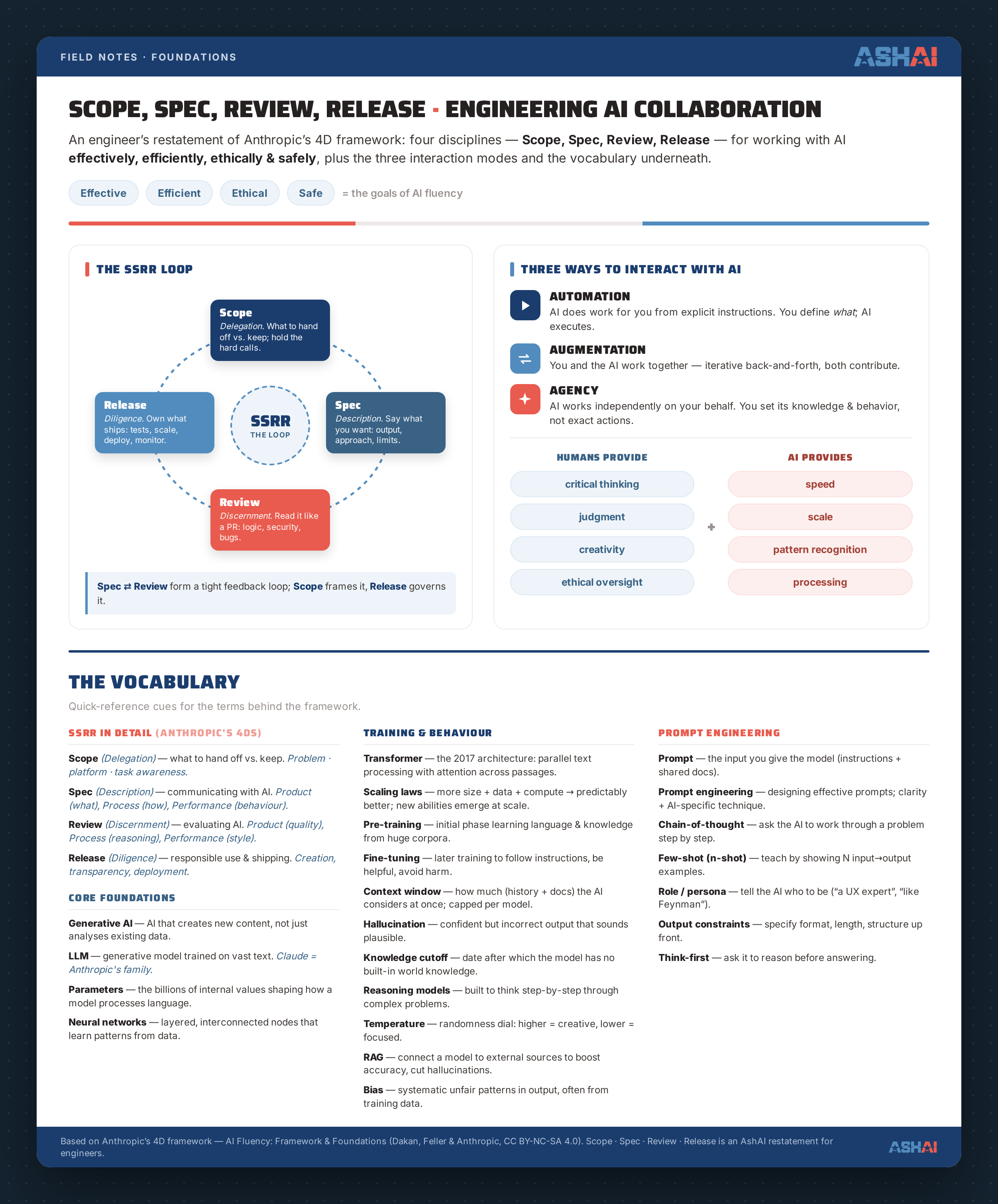
AI Fluency: 1. Three Ways to Work With AI · 2. Scope, Spec, Review, Release · 3. Leading an AI-Augmented Team
Every time you open Claude, you make a choice — most people just don't notice they're making it.
The choice is this: how much of the work do you actually want to hand over?
Because there are three ways to work with AI — and that's the only thing separating them.
Automation. You give explicit instructions, it does a defined task. Convert this file. Write the boilerplate. Format the output. You know exactly what you want; you just don't want to type it.
Augmentation. You and the AI work the problem together, back and forth. Debugging a gnarly race condition. Pressure-testing a design. Neither of you has the answer at the start — you find it in the loop.
Agency. It operates on your behalf, inside bounds you set. The overnight agent that triages your alerts. You're not specifying actions anymore; you're specifying judgment.
Most engineering work lives in the middle one. That's the mode worth getting good at first.
But almost every "AI failure" I see on a team is really a mode mismatch.
Someone hands a high-stakes architecture call to agency and wonders why it went sideways unsupervised.
Someone babysits a five-second automation task in augmentation, burning an hour chatting with a tool that just needed an instruction.
Someone stays in augmentation on work they've done a hundred times, when they should have automated it months ago.
The capability was never the problem. The mode was.
So before the prompt, ask the only question that matters: how much of this do I actually want to hand over?
The skill isn't using AI. It's knowing how much to delegate to it — and doing the diligence on what it brings back.
Automation, Augmentation, and Agency come from Anthropic's AI Fluency: Framework & Foundations (Rick Dakan, Joseph Feller & Anthropic), CC BY-NC-SA 4.0.