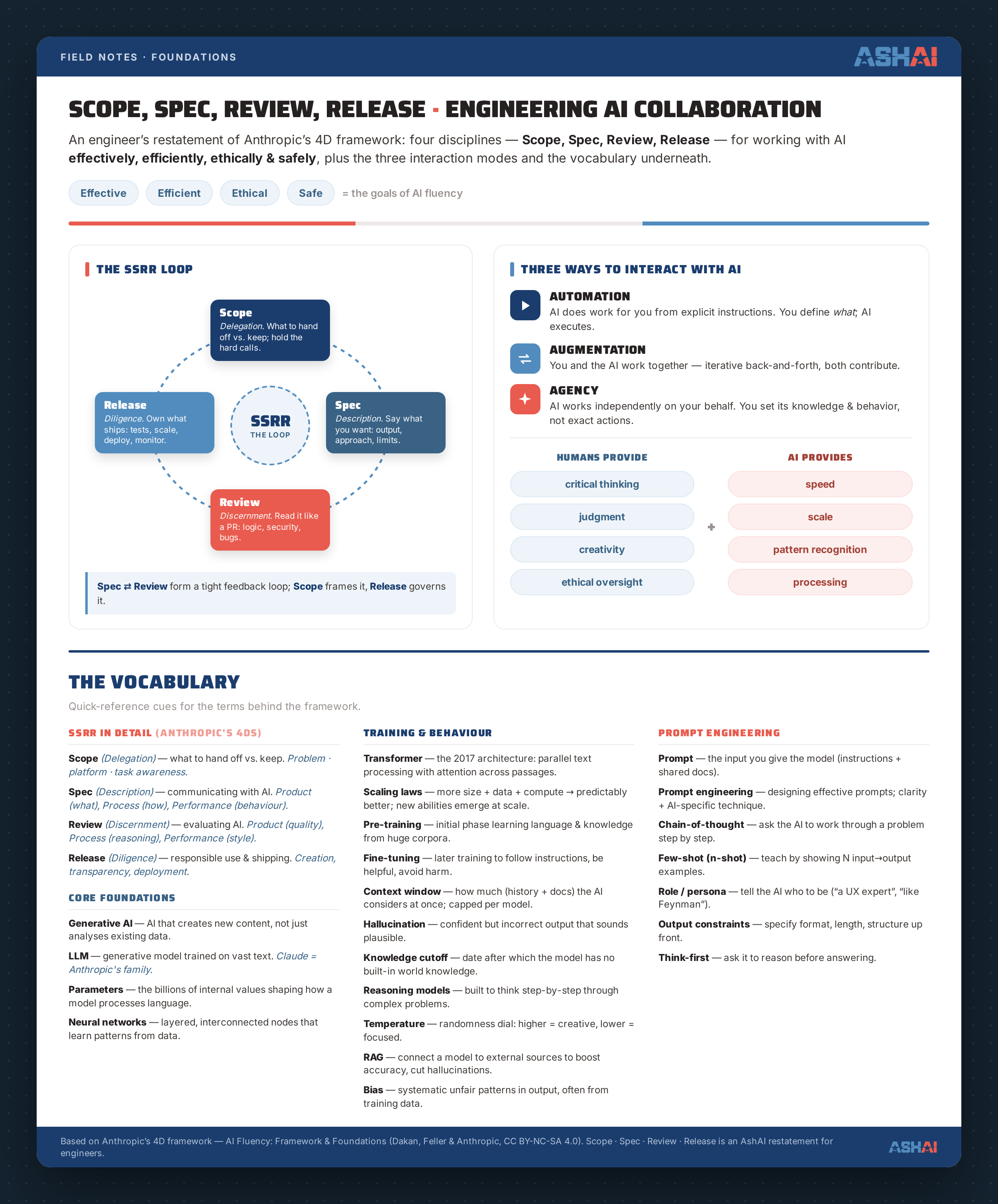
AI Fluency: 1. Three Ways to Work With AI · 2. Scope, Spec, Review, Release · 3. Leading an AI-Augmented Team
You handed the work to the AI. It came back fast, and a little wrong. Now what?
Deciding how much to hand over is one move. There are four — and most engineers only practice the first two.
Anthropic calls them the 4Ds: Delegation, Description, Discernment, Diligence. In engineering terms they're habits you already have for working with another person — four of them: Scope, Spec, Review, Release. Call it SSRR.
Scope. Decide what to hand off and what to keep. The AI isn't a drop-off chute for the whole feature — give it the function with the ugly edge cases and hold the architecture call yourself.
Spec. Say what you actually want: the output, the approach, the constraints. Treat the prompt like a well-scoped ticket — stack versions, inputs and outputs, the edge cases to handle. "Return a typed result, no prose, here's the schema" beats "clean this up."
Review. Read what comes back like a pull request, not a gift. Does it compile, is the reasoning sound, would you approve this diff with your name next to it. The output reads well and is sometimes wrong — that's the whole trap.
Release. The AI stopped typing; you are not done. Tests, scaling, privacy, the deploy, the dashboard you watch afterward. Release is everything between "it works on my machine" and "it's safe in front of users" — and if it breaks at 2 a.m., the human owns the fix, not the model.
Almost everyone is decent at Scope and Spec. The gap is Review and Release — which is exactly the half that separates a senior engineer from a junior with fast autocomplete.
And almost every "the AI wrote a bug" story I hear is really one of those last two skipped.
Someone specs it beautifully, ships without reading the diff, and meets the bug in production.
Someone distrusts the tool so much they review every token by hand — and have automated nothing in a year.
Someone blames the model for code they merged, deployed, and put their own name on.
The prompt was never the skill. The judgment around it was.
Scope, spec, review, release. You already do this with human teammates. The AI just runs the loop faster — which makes the discipline matter more, not less.
It didn't change the job. It made your judgment the bottleneck. That's exactly where it should be.
The 4Ds — Delegation, Description, Discernment, and Diligence — come from Anthropic's AI Fluency: Framework & Foundations (Rick Dakan, Joseph Feller & Anthropic), released under CC BY-NC-SA 4.0. Scope / Spec / Review / Release (SSRR) is my own restatement for engineers.